Unlock the Common Myths About an Industrial Fire Extinguisher
When it comes to fire safety in the industry, there is more to it than meets the eye. A fire extinguisher is mandatory equipment in any warehouse, factory, or production unit. However, many misconceptions exist when it comes to using and handling these critical devices. People tend to develop ideas of their own about the basic procedures involved without having any knowledge of what they are doing. It could be dangerous if a fire emergency arises.
In some cases, such beliefs may become so entrenched that even the trained employees end up following them blindly. Believing that every fire extinguisher works on every kind of fire or thinking that every unopened fire extinguisher is always ready for use are just some of the popular myths around. Experts from the industry and manufacturers of fire extinguishers constantly emphasize that knowledge is the best form of safety equipment. Nevertheless, in this blog post, we will discuss the essential myths that every individual should know before operating a fire extinguisher.
Vital Myths to Know About an Industrial Fire Extinguisher
Here are some vital myths and misconceptions about extinguishers provided by suppliers of fire extinguishers that you must know to ensure your space is end-to-end protected:
Myth 1: All Fire Extinguishers Are Effective on All Types of Fires
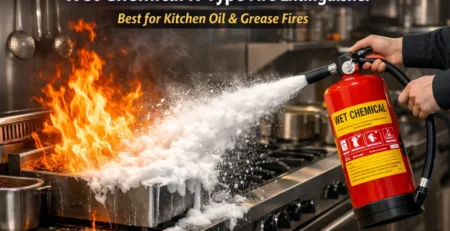
In reality, it is widely understood that using the wrong type of fire extinguisher will accelerate the fire. Industrial sectors face various risky situations and require specific agents. Water-based industrial fire extinguishers (Class A) are ineffective and dangerous on electrical (Class C) or grease (Class K) fires. Furthermore, A class D extinguisher is needed for burning metals, while ABC dry chemical is one of the best choices for general paper/liquid hazards. At the same time, using water on a flammable liquid fire can instantly make it uncontrollable.
Myth 2: If you don’t use a fire extinguisher, it does not expire
In reality, the fire extinguishers provided by manufacturers of fire extinguishers last about 5 to 15 years. Although the fire extinguisher may not be used at all, due to the passage of time, the dry chemicals in them can clump together, the pressure level in them will be reduced, and the seals can wear out; in case of an emergency where there is a very bad fire condition, the fire extinguisher may fail. CO2 extinguishers have a longer lifespan but require regular hydrostatic testing.
Myth 3: Maintenance is Only Needed After It’s Been Used
In reality, even when an inactive fire extinguisher is not in use, it still requires daily maintenance and monthly inspections by professional suppliers of fire extinguishers. In an industrial environment, vibration, temperature fluctuations, and dust could interfere with equipment pressure, clog the nozzle, or damage the seals. Similarly, the fire extinguisher must undergo an annual inspection by experts in accordance with fire codes, such as NFPA 10.
Myth 4: A Partial Discharge Means it is perfect for further use
In reality, once the safety pin is pulled and the handle is squeezed, even for one second, the fire extinguisher loses pressure. A “partial discharge” means the pressurized seal is damaged, and the unit will likely lose its remaining pressure over the next few hours or days. After using industrial fire extinguishers, ensure you immediately opt for recharge or replacement from the manufacturer to ensure they are ready for the next use in sudden emergencies.
Myth 5: Aiming Directly at the Top of the Flames Can Stop the Fire
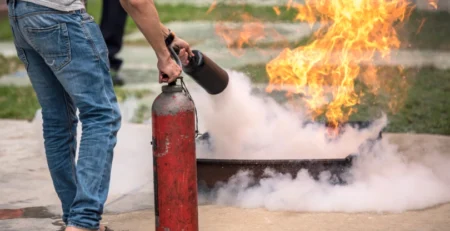
In reality, it is a common cinematic mistake that is useless in reality. When dealing with an uncontrollable fire, it is vital to aim the nozzle of your fire extinguisher at the base of the fire, not at the flames. When you aim at the top of the flames, the fire automatically spreads and becomes more intense, and it is also a waste of fire extinguishing agent. For dry-chemical extinguishers, sweeping from side to side at the bottom cuts off the fuel source.
Things To Consider When a Fire Extinguisher Fails Inspection
One of the significant benefits of having a fire extinguisher and maintaining it properly is that it is easily accessible whenever you are dealing with a fire situation. Furthermore, industrial fire extinguishers that have not passed the inspection list should not be used immediately. Additionally, whether the extinguishers are repaired, replaced, or recharged depends entirely on the issue and the extinguisher type. We have compiled some vital examples that you must know:
1. Physical Damage, Missing Parts, or Corrosion
After an end-to-end inspection, these industrial fire extinguishers are removed or replaced.
2. Exceed Service Life or Failed Hydrostatic Test
Manufacturers of fire extinguishers ensure that any extinguishers that fail the pressure test or have exceeded their shelf life are permanently removed, and a new extinguisher is issued immediately.
3. Partial Discharge or Low Pressure
The rechargeable fire extinguishers usually need to be recharged by a certified individual. The extinguisher will then have to be reinspected and tagged accordingly before being put back into use.
It is imperative to remember that, when changing the extinguishers, businesses should install devices that comply with code, not simply those that were there previously.
Concluding Here!
If you want to ensure your industrial setting is properly safeguarded and can handle any type of fire, choose Fire Extinguishers India. With our years of experience, we are one of the best suppliers of fire extinguishers, providing the best design, installation, inspection, and maintenance services for residential, commercial, and industrial properties. If you are interested in learning more about our high-end services and protecting your spaces, connect with us instantly via WhatsApp at +91-9811141246 or email us at info@fireextinguishersindia.com / somyapyroteksales@gmail.com.
FAQs
Ans: By no means. Although a fire extinguisher was never used, it has an expiration period of 5 to 15 years. Moreover, its internal pressure might decrease, or the chemicals inside become aggregated. Thus, it is necessary to inspect them regularly.
Ans: Certainly not. Fire extinguishers require periodic maintenance regardless of whether they have been used. In addition, conditions in industrial settings may damage them due to dust, vibrations, or temperature fluctuations. Hence, it is recommended to perform inspections every month and servicing annually.
Ans: It is not allowed to use a fire extinguisher after a partial discharge, as releasing internal pressure can cause it to fail completely. Consequently, it should be recharged and used again.
Ans: Such action is incorrect because one should point a nozzle at the fire base. By aiming the fire extinguisher at the flame, one just makes it flicker. To suppress a fire, it is necessary to cut off the fuel.
Ans: In case of failure, one cannot use it anymore. It needs servicing due to its malfunction. Repairing, recharging, and replacing depend on the problem. However, it is recommended to entrust servicing only to a professional.