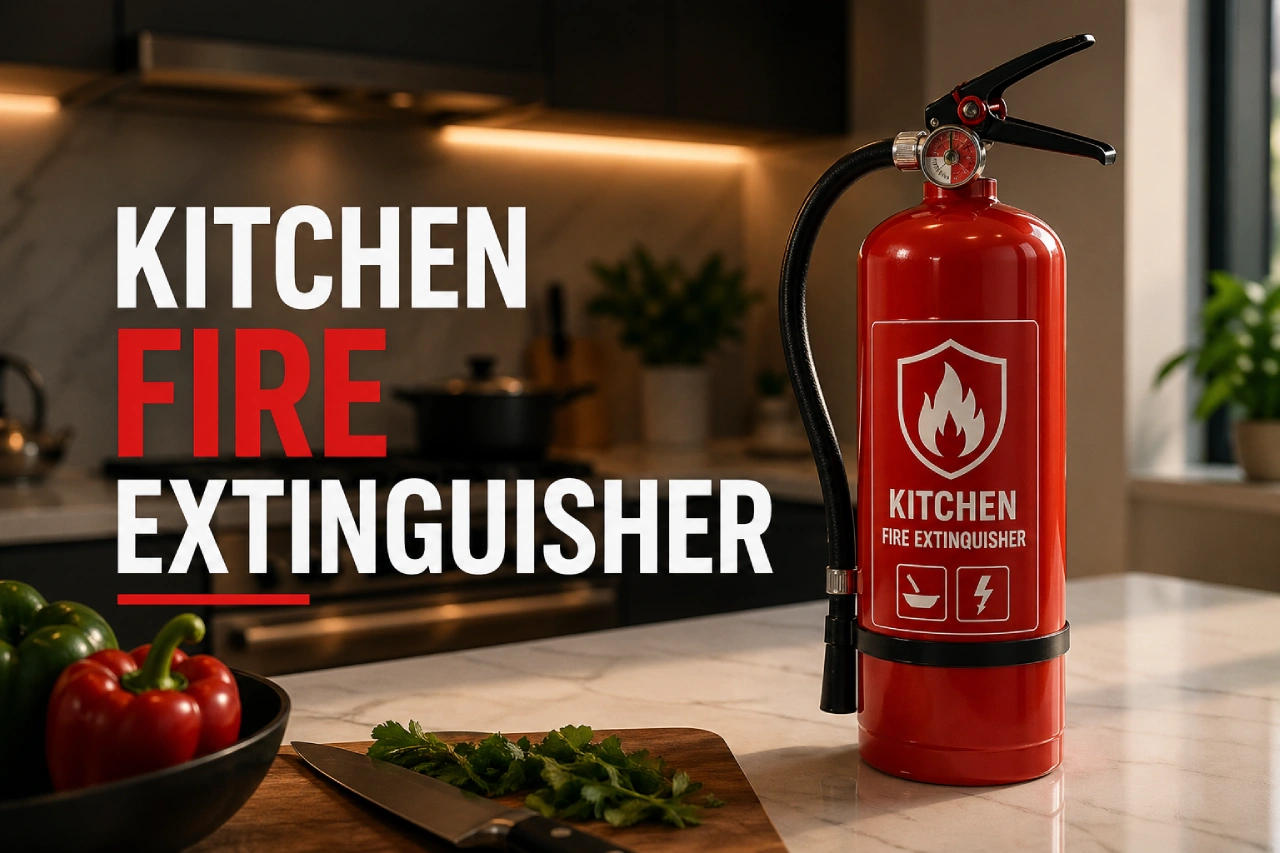
Kitchen Fire Extinguisher Complete Guide to Safety, Types & Proper Use
The K-type kitchen fire extinguisher is an advanced fire extinguishing device specifically designed for Class K fires involving fats, greases, and cooking oils. Furthermore, this type of extinguisher is commonly found in commercial kitchens and uses potassium-based agents. Additionally, it works through saponification, in which the chemical reacts with hot oil to form a soapy foam that smothers the fire.
At the same time, the mist provides intense cooling, lowering the oil temperature below the autoignition point and preventing re-ignition. It is highly effective, prevents splashing, and causes minimal residue compared to dry chemicals. Moreover, in this comprehensive guide, we will discuss the vital role of the wet-chemical K-type extinguisher in your home. So, let’s get started!
Key features of Wet Chemical K-Type Fire Extinguisher
- The wet chemical K-type extinguishing agent is designed to cool the oil down to well under its auto-ignition point, via the oil.
- The nozzles dispense a mist, rather than a strong stream, thus avoiding any oil being sprayed around while attempting to douse the flames in the kitchen.
- The agent is a special liquid that is composed of Potassium Acetate, Citrate, or Carbonate. It mixes with the grease and forms soap-like foam to extinguish the flames.
- These are designed for use against Class K fires, but also work well when dealing with Class A fires (e.g., paper, textile, wood, etc.)
- They are manufactured using stainless steel and have great durability and resistance to extreme heat and chemicals.
Technical Configurations of a Wet Chemical K-Type Extinguisher
| Parameter | Specification / Description |
|---|---|
| Extinguisher Type | Wet Chemical (Class K / Class F) |
| Primary Application | Cooking oils, fats, grease fires (deep fat fryers, commercial kitchens) |
| Extinguishing Agent | Potassium acetate/potassium citrate/potassium carbonate solution |
| Fire Class Rating | Class K (US) / Class F (EU & India) |
| Cylinder Material | Mild steel or stainless steel, corrosion-resistant coating |
| Capacity Options | Typically 2L, 3L, 6L, 9L |
| Operating Pressure | 7–15 bar (varies by model) |
| Propellant Type | Stored pressure (nitrogen) or cartridge-operated |
| Discharge Time | 10–60 seconds depending on capacity |
| Discharge Range | 1–4 meters |
| Operating Temperature Range | 40°F to 120°F (4°C to 49°C) |
| Nozzle Type | Use a low-velocity applicator or spray nozzle to prevent splashing |
| Hose Length | Typically 0.5–1 meter (for larger units) |
| Mechanism of Action | Saponification (forms a soap-like foam layer over burning oil) + cooling effect |
| Mounting Type | Wall-mounted bracket or floor stand |
| Safety Features | Pressure gauge, safety pin, tamper seal |
| Refill / Recharge Interval | After use or periodic servicing (usually annually) |
| Standards Compliance | IS 15683 (India), EN 3 (Europe), UL / NFPA (USA) |
| Color Coding (India) | Cream label on red cylinder |
| Typical Weight (Full) | 4–15 kg depending on size |
| Maintenance Requirements | Regular inspection, pressure check, and hydrostatic testing every 3–5 years |
Why Wet Chemical K-Type Extinguisher Works Best for Kitchen Fires?
The K-type wet-chemical kitchen fire extinguisher is specifically designed to extinguish kitchen fires. The reason is that this type of fire extinguisher is ideal for areas prone to fire hazards caused by hot cooking fats or oils. The reason is that these types of fire extinguishers use unique chemicals that extinguish the fire in two steps. Firstly, when sprayed, the wet chemical mixes with the fire, causing fats to melt and resulting in soapy foam suffocation.
Furthermore, it is worth noting that once cooking oil gets too hot, it can easily catch fire again. In addition to being more efficient than using water (which can cause burning oil to splash) and dry chemical types, which do not cool the fire sufficiently, this fire suppression process occurs in a more controlled manner and reduces the risk of hazards such as injury to people in the environment. Thus, the extinguisher comes with a long nozzle to ensure one stays at a safe distance from the fire.
Some Vital Significance of Placing Wet Chemical K-Type Fire Extinguishers in the Kitchen
Here are some essential reasons for placing a wet chemical kitchen fire extinguisher in the kitchen to prevent sudden fire situations:
1. They are Specifically Designed for Kitchen Fires
Fire extinguishers come in a wide variety, each one tailored for a specific type of fire. Grease fires are one such type that require special measures for effective management. Unlike paper or wood, cooking oils, fats, and grease do not behave like other materials when they catch fire. This is where wet chemical K-type extinguishers prove to be the best tool for the job. Not only do they extinguish the flames quickly, but they also induce reactions that convert burning grease into a soap-like substance that serves as a barrier, isolating the fire from the oxygen source. This process is called saponification.
2. They Rapidly Lower the Temperature of Hot Oils
The temperature at which cooking oils catch fire is way higher than the average person would imagine. Once the critical point is reached, the fires will ignite and spread without a doubt. Using water to extinguish a fire caused by overheated oil is the least desirable option because it increases the likelihood of oil spattering and spreading flames. This problem is solved with a wet-chemical kitchen fire extinguisher, as the released mist quickly lowers the temperature of the burning oil.
3. They Reduce the Chances of Fire Spreading Again
Another dangerous trait of kitchen fires is their tendency to flare up repeatedly until all the fuel is burned. Such an occurrence is known as re-ignition or reflash, meaning that if the oil is still hot after the flames were extinguished, it can cause another fire to start. A wet-chemical kitchen fire extinguisher has a unique feature: it forms a soapy layer on the surface of burning oils. This layer keeps oxygen away and allows oil to cool effectively, preventing reignition.
4. They are Safe and Easy to Apply and Clean Up
There are multiple types of fire extinguishers, some of which have proven less effective in kitchen situations. For example, powder-type dry extinguishers are difficult to apply safely due to their high messiness, which can contaminate food or damage appliances in your kitchen. Besides, wet chemical agents leave less residue after application and are designed with longer hoses equipped with nozzles, allowing the user to stay farther away from the fire.
Install a High-Quality Class K Fire Extinguisher to Safeguard Your Kitchen!
A fire can break out in your kitchen at any time without giving you any warning. Therefore, it is significant to install a kitchen fire extinguisher to safeguard the area from every corner. Well! We hope this blog has provided you with clear reasons to install a fire extinguisher. However, if you are searching for a reliable manufacturer to purchase a K-Type fire extinguisher, look no further than Somya Pyrotek Services Pvt. Ltd. We offer a wide range of high-quality fire extinguishers, especially designed for your kitchen.
So, do not take any risks with making fire defenses. Ensure to rely on purpose-built wet-chemical fire extinguishers. Somya Pyrotek Services Pvt. Ltd. has years of experience in manufacturing fire protection equipment and deploying these specialized units for a wide range of uses. No need to waste your time searching for the right kitchen fire extinguisher. Contact us today to get expert wet-chemical fire safety solutions for your residential property.
Frequently Asked Questions
Ans: Class K extinguishers are often thought to be only for commercial kitchens, but in reality, they are highly recommended for your home kitchen, especially if you use a lot of oil or deep-fry.
Ans: Water will create additional risks when dealing with oil fires. It vaporizes almost instantly upon contact with hot oil. This causes splashing and even increases the danger of spreading fire. Furthermore, it is best to use a wet chemical extinguisher.
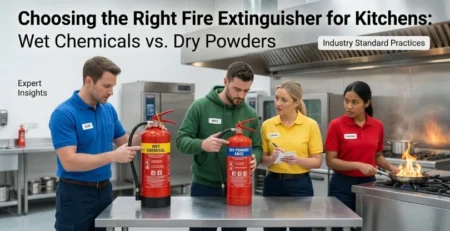
Ans: Wet extinguishers are meant especially for oil fires, while dry ones can handle any kind of fire. The second thing is that dry chemicals do not have a cooling effect and leave a mess after being used, while wet ones do both – cool down and prevent flames from igniting again.
Ans: Regular maintenance is key to the proper operation of this equipment in case of an emergency.
- Check the pressure gauge each month
- Get the service done by experts annually
- Refill/recharge straight after service
- Store in a dry and easily available place
Ans: Depending on your kitchen space and activities taking place there, you might need different sizes. A small domestic kitchen will be enough with a 2L or 3L extinguisher. However, larger restaurant kitchens may require a 6L or 9L extinguisher.