
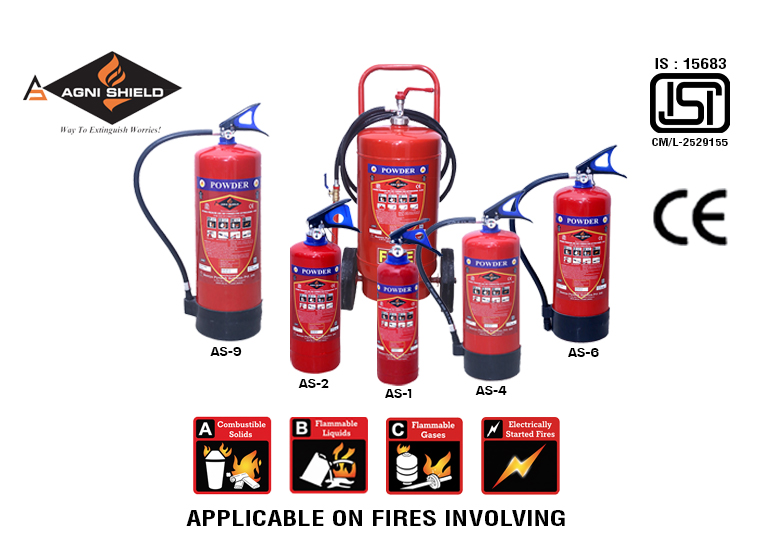
Industrial Fire Extinguishers
Product Specification
- Capacity: 4.5kg, 5kg, 6kg, 7kg, 8kg, 9kg
- Fire Class: Class A, B, C, D, or K
- Operating Temperature: -65°F to 120°F (-54°C to 49°C)
Product Description:
Industrial fire extinguishers are heavy-duty, high-performance safety equipment designed for rapid responses to fires in manufacturing, high-hazard environments, and commercial buildings. Furthermore, these fire extinguishers are manufactured for reliability and durability, often featuring corrosion-resistant steel cylinders, robust brass valves, and specialized extinguishing agents formulated to address specific high-risk fire classes (A, B, C, D, or K).
Additional Details:
- Brand: Somya Pyrotek Services Pvt. Ltd.
- Model: Industrial Fire Extinguisher
- Capacity: 4.5 kg – 9 kg
- Maximum Coverage Area: 75 ft
- Temperature Range: -65°F to 120°F (-54°C to 49°C)
- Working Pressure: 15 – 19 bar
- Rechargeability: Refillable
- Cylinder Material: Aluminum Alloy and Stainless Steel
- Agent Release Time: 8 to 35 seconds
Key Features of ABC Fire Extinguisher
Here are the key features of industrial fire extinguishers that you must know before installing them to safeguard your space from sudden fire situations:
- Industrial extinguishers are designed with large agent capacities to handle sudden fires.
- These extinguishers are pressurized to higher levels to ensure a sustainable range and faster discharge rate.
- They often include specialized agents, such as CO2 for electrical or Class D powder for metal fires.
- They feature durable metal cylinders designed to withstand harsh environments, potential corrosion, and rough handling.
- These extinguishers are manufactured with brass or metal valves. Thus, it makes them fully serviceable, refillable, and repairable by industry experts.
Applicable Areas of Industrial Fire Extinguisher
- Manufacturing Plants & Workshops
- Commercial Kitchen
- Chemical Processing Facilities
- Data Centers & IT Server Rooms
- Oil & Gas Refineries
- Warehouses & Storage Facilities
- Vehicle & Heavy Machinery Bays
- Laboratory Environments
- Construction Sites
- Electrical Substations & Power Plants
Technical Configuration of Industrial Fire Extinguisher
| Parameter | ABC Dry Powder Extinguisher | CO₂ Extinguisher | Foam (AFFF) Extinguisher | Clean Agent Extinguisher |
| Typical Application | General industrial fire protection | Electrical & flammable liquid fires | Oil, fuel, and chemical fires | Sensitive electronic equipment |
| Fire Class Coverage | A, B, C | B, C | A, B | A, B, C |
| Extinguishing Agent | Mono ammonium phosphate powder | Carbon dioxide gas | Aqueous Film Forming Foam | Clean gaseous agent |
| Capacity Range | 2–50 kg | 2–45 kg | 6–75 L | 2–10 kg |
| Discharge Time | 8–25 sec | 8–30 sec | 20–60 sec | 10–20 sec |
| Discharge Range | 3–7 m | 1–4 m | 4–8 m | 2–5 m |
| Cylinder Material | Mild steel/alloy steel | Seamless steel | Stainless steel / mild steel | Alloy steel |
| Propellant | Nitrogen gas | Self-expelling CO₂ | Nitrogen gas | Nitrogen gas |
| Hose Length | 0.5–5 m | 1–5 m | 1–10 m | 0.5–2 m |
| Mounting Type | Portable / trolley mounted | Portable / trolley mounted | Portable / trolley mounted | Portable |
| Refill Interval | Every use or annual inspection | Every use or annual inspection | Every use or annual inspection | Every use or annual inspection |
| Hydrostatic Test Period | Every 5 years | Every 5 years | Every 5 years | Every 5 years |
| Standard Compliance | IS 15683 / NFPA 10 | IS 2878 / NFPA 10 | IS 4989 / NFPA 11 | NFPA 2001 |
How to Use an Industrial Fire Extinguisher?
Fires can happen at any time, in any situation, whether in the kitchen, a house, an office, or even in a car. This is why using the right industrial fire extinguishers is so imperative in a real-time situation. Furthermore, let’s discuss how to use industrial fire extinguishers in a fire situation:
Step 1: Assess the Situation Calmly
If a fire erupts, you shouldn’t panic. First, check whether the fire is manageable. If the fire cannot be controlled, leave the area and inform the fire services right away. The fire extinguishers can only be used to put out fires in their early stages.
Step 2: Identify an Industrial Fire Extinguisher
Ordinarily, an industrial fire extinguisher is red. The letters ‘Industrial’ are printed prominently on them. They have dry chemical powder inside, which smotheres the flames, thereby depriving them of oxygen.
Step 3: P.A.S.S. Technique
As advised by fire safety experts, there is a trick that makes it easier to use a fire extinguisher effectively. It is the acronym PASS, and it will be very useful.
- P (Pull)
Firstly, pull out the pin from the industrial fire extinguisher. Note that this pin protects the extinguisher from accidental discharge.
- A (Aim)
Secondly, aim the nozzle directly at the base of the fire. Remember, the fire starts spreading from the base, so it’s advisable to aim the nozzle towards it.
- S (Squeeze)
Next, squeeze the handle. As a result, the powder will be forcefully discharged, and the flames will be subdued immediately.
- S (Sweep)
Finally, sweep the nozzle from side to side. You shouldn’t keep the nozzle aimed at the base of the fire alone; you have to move it to cover the whole area.
Step 4: Maintain Proper Distance
When using a fire extinguisher, ensure you are 6-8 feet away from the fire. This is because, if you are closer to the fire, you’ll feel the intensity of the heat, hence the ineffectiveness of the powder.
Step 5: Keep Working Until the Fire Is Completely Out
In some cases, the fire can be put out with the first spray. This means fire safety in the office/home can be assured through your efforts. But not always. Hence, continue spraying until the flames are out completely. Moreover, if they reignite, continue spraying until they go down again.
Step 6: Remain Careful Even After the Fire is Out
Never try to approach the area where there was fire right after putting out the flames. You may find that some parts are still hot, and there is a risk of the fire being reignited. It is better to give the area some time and observe.
Safety Tips for an Industrial Fire Extinguisher
Industrial fire extinguishers are a key first-response tool in a fire situation. To ensure they are effective, follow these fundamental safety tips regarding their maintenance, usage, and selection:
- Ensure the extinguisher matches the fire hazard (for instance, Class A for paper/wood, Class B for flammable liquids, Class C for electrical fires, or Class D for metals). If you don’t use the right fire extinguisher, it can be dangerous or ineffective in any fire situation.
- It is highly visible, accessible, and unobstructed locations, typically near exit paths.
- At least every 30 days, visually inspect extinguishers. The needle on the pressure gauge must be in the green zone, neither too high nor too low.
- Never try to fight a fire alone. Pull the fire alarm first to alert others and call for emergency services before trying to use an extinguisher.
- An extinguisher is useless if you cannot reach it. Ensure no tools, boxes, or waste are blocking the extinguisher, and it is easily visible on the wall.
Maintenance and Inspection Tips of an Industrial Fire Extinguisher
Check out the key maintenance and inspection tips for industrial fire extinguishers:
1. Ensure Immediate Visibility and Access
Ensure extinguishers are never blocked by debris, inventory, or machinery. They must be easily accessible and keep the area clear at all times.
2. Conduct Mandatory Monthly Visual Check Up
Check the fire extinguisher every month to ensure the unit is in place and appears ready to use.
3. Check Pressure Gauge Readings
Make sure to check the gauge to ensure the needle is in the green zone. If the needle is in the read (overcharged or undercharged), it must be serviced immediately.
4. Verify Safety Pin and Tamper Seal
Ensure that the plastic tamper seal and the metal pin are in place and not broken. Moreover, a broken or missing seal indicates the extinguisher might have been used or partially discharged and needs a professional check.
5. Inspect the Condition of the Extinguisher in Person
It is significant to inspect the cylinder, handle, and lever for signs of dents, chemical corrosion, or rust. In harsh industrial settings, corrosion can compromise the extinguisher’s integrity.
Why Choose us When Buying an Industrial Fire Extinguisher?
At Fire Extinguishers India, we believe that industrial safety should never be compromised when it comes to safety precautions. For this reason, our industrial fire extinguishers deliver reliable, efficient performance for factories, warehouses, plants, and other commercial businesses. Our main goal is to provide quality, durable products that meet safety regulations, assuring our customers that they made the right choice. In addition, with many years of experience in providing firefighting solutions, our experts will help you choose the appropriate extinguisher for your facility.
- High-performance certified extinguishers for industrial use.
- Reasonable prices that do not undermine safety or quality.
- Prompt delivery, reliable support, and recommendations regarding maintenance.
- Durable and certified products to ensure long-term protection and safety.
- A wide range of products for various fire risks in industries.
- We provide professional assistance in selecting the right extinguisher for your needs.
If you need any further assistance while choosing the right industrial fire extinguisher, feel free to contact us today. Our support team is here to assist you!
Frequently Asked Questions
When dealing with electrical fires, the appropriate extinguishers to use are either CO₂ or a clean agent, since they leave no residue that can be highly conductive. The following are some places where they would work best:
- Data centers or server rooms
- Electrical substations
- Control panels or switching rooms
- Labs where there is sensitive equipment
- IT infrastructure facilities
An industrial fire extinguisher should undergo regular:
- Monthly visual inspections
- Annual servicing by professionals
- Hydrostatic testing every five years
Fire classes and their corresponding fire extinguishing methods are:
- Class A fire – wood, paper, textiles, other combustibles.
- Class B fire – oil, fuel, paint, and flammable liquids
- Class C fire – fires involving energized electrical equipment
- Class D fire – fires in metallic elements such as aluminum and magnesium
- Class K fire – commercial kitchen grease and oil fires
PASS is an acronym that is used when operating industrial fire extinguishers. The following are what it stands for:
- P – Pull the safety pin
- A – Aim the nozzle towards the base of the fire
- S – Squeeze the trigger to activate the extinguishing agent
- S – Sweep the base of the fire using the nozzle
Yes, industrial fire extinguishers can be refilled. After their usage, the following are done to them:
- Refilling the extinguishing agent into the container
- Repressurizing of the cylinder
- Inspection of all components to ensure proper function
- Ensuring the extinguisher complies with safety regulations