
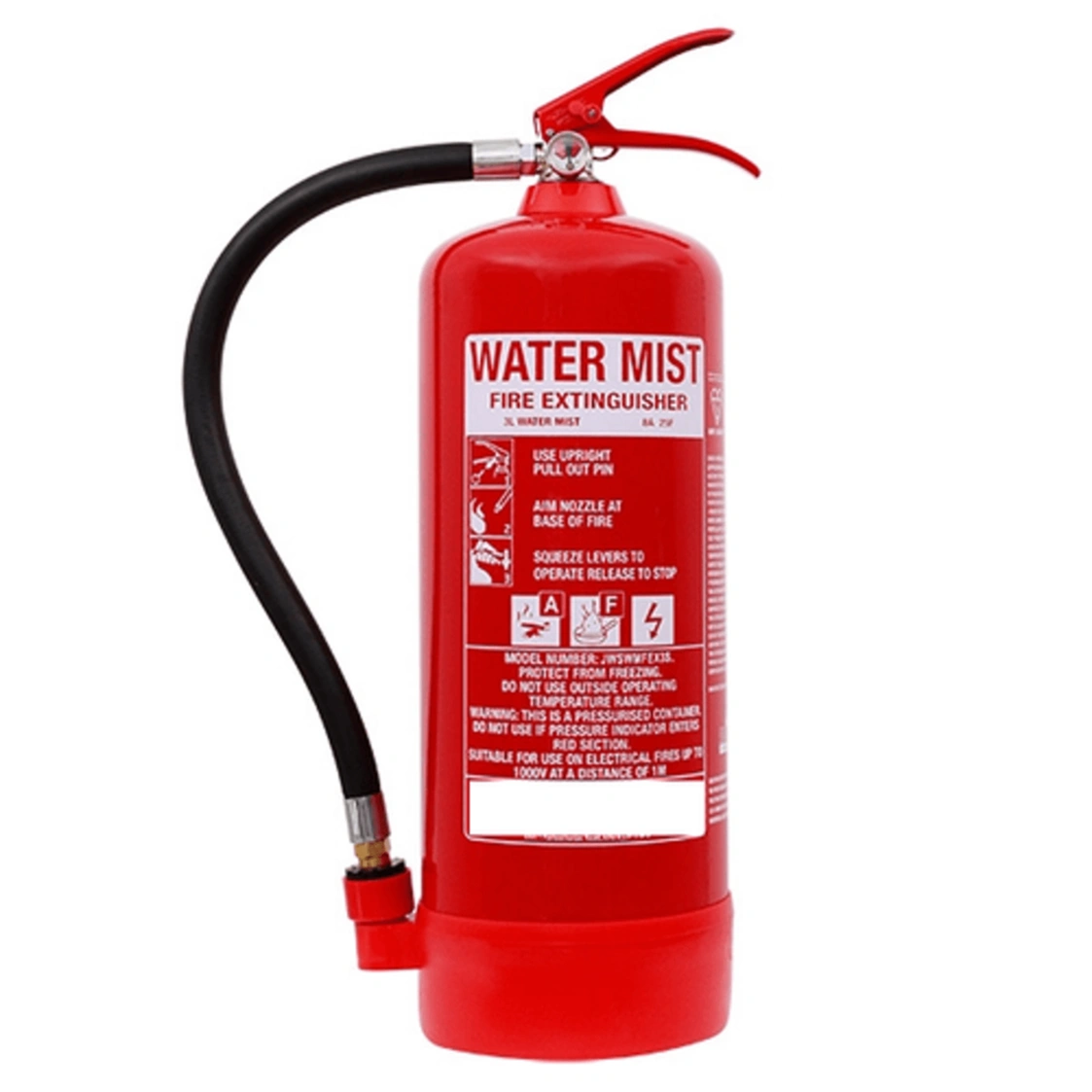
Water Mist Fire Extinguishers
Product Description:
Water mist fire extinguishers are a modern, versatile firefighting tool that discharges deionized water in ultra-fine, microscopic droplets (40-60 microns) to extinguish fires by immediate cooling and oxygen removal. Additionally, these tiny particles act as a “dry” mist that instantly evaporates upon contact with a flame, absorbing immense heat (cooling) and creating steam that replaces oxygen (smothering). Furthermore, it is safe and secure for Class A, F, and electrical fires (up to 1000V), making it ideal for offices, kitchens, and hospitals. It leaves no residue and causes minimal collateral damage, making it exceptional for libraries, clean rooms, and hospitals.
Additional Details:
- Brand: Somya Pyrotek Services Pvt. Ltd.
- Model: Water Mist Fire Extinguishers
- Capacity: 3 kg / 6 kg / 9 kg
- Fire Classes: Class A, Class F (K), limited Class B
- Operating Pressure: 10–15 bar
- Droplet Size: 20–60 microns
- Cylinder Material: Steel / Aluminum / Composite
- Valve Type: Brass / Stainless steel
Key Features of Water Mist Fire Extinguishers
Below are the precise features of a water mist fire suppression system offered by top fire extinguisher manufacturers that you must know before planning to purchase it:
- The nozzle atomizes water into microscopic droplets (normally 20-200 micrometers), providing a large external surface area for rapid heat absorption and instant evaporation.
- Water mist fire extinguishers are effective on Class A fires (solid combustibles), Class F/K fires (cooking fats and oils), and electrical fires up to 1000V.
- Fire extinguisher manufacturers ensure that this extinguisher is designed with non-conductive properties, which is safe for electrical fires, as it uses deionized water, which has no minerals. Thus, it is one of the main reasons this fire extinguisher is safer for use on electrical equipment, in hospitals, and in data centers.
- Unlike foam or powder, a water mist fire suppression system leaves behind no chemical contamination or powder residue, minimizing cleanup and securing sensitive equipment.
- They extinguish through three mechanisms, including oxygen displacement (via steam expansion), radiant heat attenuation, and rapid cooling.
- They only use water with no additives, which makes them environmentally friendly, safe for humans & pets, and contains non-toxic properties.
- Water mist fire extinguishers operate at high pressure (e.g., 8 to 15 bar). Furthermore, these extinguishers provide a robust, effective range for suppressing fires from a secure distance.
Applicable Areas of Water Mist Fire Extinguishers
- Hospitals and Healthcare Facilities:
- Libraries and Archives
- Commercial Kitchens and Restaurants
- Office Buildings
- Schools and Nurseries
- MRI Rooms and Clean Rooms
- Telecommunication Facilities
- Hotels and Residential Buildings (HMOs)
- Museums and Art Galleries
- Data Centers and Server Rooms
Technical Configuration of Water Mist Fire Extinguishers
| Parameter | Typical Specification |
| Extinguishing Agent | Deionized Water (Water Mist) |
| Extinguishing Principle | Fine mist cooling + oxygen displacement |
| Fire Classes | Class A, Class F (K), limited Class B |
| Capacity | 3 kg / 6 kg / 9 kg |
| Operating Pressure | 10–15 bar |
| Propellant Gas | Nitrogen (N₂) |
| Discharge Time | 10–25 seconds |
| Discharge Range | 2–4 meters |
| Nozzle Type | Fine atomizing nozzle |
| Droplet Size | 20–60 microns |
| Cylinder Material | Steel / Aluminum / Composite |
| Internal Coating | Anti-corrosion lining |
| Valve Type | Brass / Stainless steel |
| Hose Type | Rubber or reinforced polymer |
| Working Temperature | 0°C to +60°C (typical) |
| Weight (6 L unit) | 9–12 kg |
| Mounting | Wall bracket |
| Safety Relief Device | Pressure relief valve/burst disc |
| Maintenance Interval | Annual inspection (typical) |
| Refill Method | Water refill + pressurization |
| Standards | EN3 / BS / NFPA (varies) |
How to Use a Water Mist Fire Extinguisher?
Check the signs on the front of the fire extinguisher to determine what type of fire it can be used on. Furthermore, most water mist fire extinguishers are the right fit to use on Class A, Class B, Class C, Class F, and electrical tool fires. If the fire has taken hold, do not fight it. Ensure to evacuate immediately and warn others. Call the fire and recovery service. Nevertheless, if you tackle the fire, ensure you stay at a safe distance and follow the instructions below:
- Pull: With the nozzle pointing out, pull the safety pin to break the seal and unlock the lever.
- Aim: Direct the lever low, aimed towards the fuel source at the bottom of the fire, not the flames. Furthermore, ensure to maintain a safe distance of 6 to 8 feet initially, moving closer as the fire subsides.
- Squeeze: Carefully press the handle to release a fine mist that cools the fire, displaces oxygen, and helps prevent reignition.
- Sweep: Move the nozzle of the extinguisher across the bottom of the fire until the flames are extinguished. Additionally, monitor for reignition and repeat as needed, using the entire contents to thoroughly cool the area.
Safety Tips for Water Mist Fire Extinguisher
After buying a water mist extinguisher from a reliable fire extinguisher supplier, you must be aware of some crucial safety tips that are mentioned below.
- While water mist fire extinguishers are typically safe on live electrical tools up to 1000V, always ensure the unit is particularly rated for Class C (electrical) fires before use.
- When using the extinguishers, remember to use the PASS method (Pull, Aim, Squeeze, and Sweep)
- Ensure to stand at least one meter (approximately 3 feet) from the fire to allow the water mist to cover the entire area effectively without scattering burning materials.
- Direct the lever at the bottom of the fire, not directly at the flames. It is the best way to ensure the water mist cools the fuel source effectively.
- These water mist fire extinguishers are excellent for Class A (textiles, wood, and paper) and Class C (electrical) fires. Additionally, they are also highly effective on Class K (kitchen grease) fires.
- Always keep your back to an exit to ensure you have a safe, clear escape route if the fire can not be extinguished.
- Before using the extinguisher designed by the top fire extinguisher supplier, don’t forget to check the pressure gauge to ensure the needle is in the green zone, indicating it is fully pressurized and functional.
Maintenance Tips To Know About Water Mist Fire Extinguisher
Here are maintenance tips for water mist fire extinguishers to help extend their lifespan.
- Check that the fire extinguisher is in its designated location, unobstructed, and the pressure gauge needle is in the green zone. Ensure the lever seal is intact to confirm it has not been used or tampered with.
- Ensure the extinguisher is appropriately pressurized (needle in the green). Furthermore, water mist fire extinguishers require a stable pressure to atomize. Likewise, any drop in pressure requires immediate professional service.
- If the unit requires recharging, use only deionized or distilled water. Alsom standard tap water contains minerals that can cause internal corrosion, clog the nozzle, and reduce the mist effectiveness.
- Water mist fire extinguishers depend on a specialized, high-pressure nozzle. Ensure that it contains no dust, dirt, or debris. Do not insert objects into the nozzle during cleaning.
- Examine the cylinder for dents, corrosion, or rust. Likewise, water-based units are particularly susceptible to rust, so any signs of structural damage should prompt immediate replacement or inspection.
Why Choose Us to Buy a Water Mist Fire Extinguisher?
Selecting the appropriate fire extinguisher is critical to fire safety. Water Mist Fire Extinguishers are the latest and most efficient technology, addressing a range of fire hazards safely, especially in offices, homes, hospitals, server rooms, and business environments. At Fire Extinguishers India, we not only offer safety products but also comprehensive safety solutions. Our aim is to ensure quality, reliability, and customer satisfaction, and to provide you with a fire extinguisher that performs well in genuine emergencies.
Furthermore, the most significant benefit of water mist fire extinguisher technology is that it not only extinguishes the fire but also cools it and quickly suppresses flames by cutting off the oxygen supply, minimizing water damage. Nevertheless, here are some key points that set us apart when it comes to finding the best fire extinguishers.
- High-quality, certified Water Mist Fire Extinguishers
- Appropriate models for residential, office, hotel, hospital, and industrial use
- Professional advice on proper extinguisher selection
- Competitive prices with trusted service support
- Quick availability and easy purchasing process
- Safety-first assurance with reliable performance
Frequently Asked Questions
It functions in three ways to extinguish the fire:
- Cooling: It absorbs heat and cools the temperature
- Smothering: It displaces oxygen to form steam
- Reduces radiant heat: It slows down the spread of fire
Yes, most water mist extinguishers are safe for electrical fires (up to 1000V), since they use deionized water, which is non-conductive. However, always check the label to be safe.
It uses deionized water (not normal tap water).
- Tap water contains minerals that:
- Can rust the cylinder
- Clog the nozzle
- Damage mist quality
Absolutely not! The biggest advantage of a water mist extinguisher is that:
- No powder residue
- No foam mess
- Minimal water damage
It is best suited for use in libraries, hospitals, clean rooms, and data centers.