
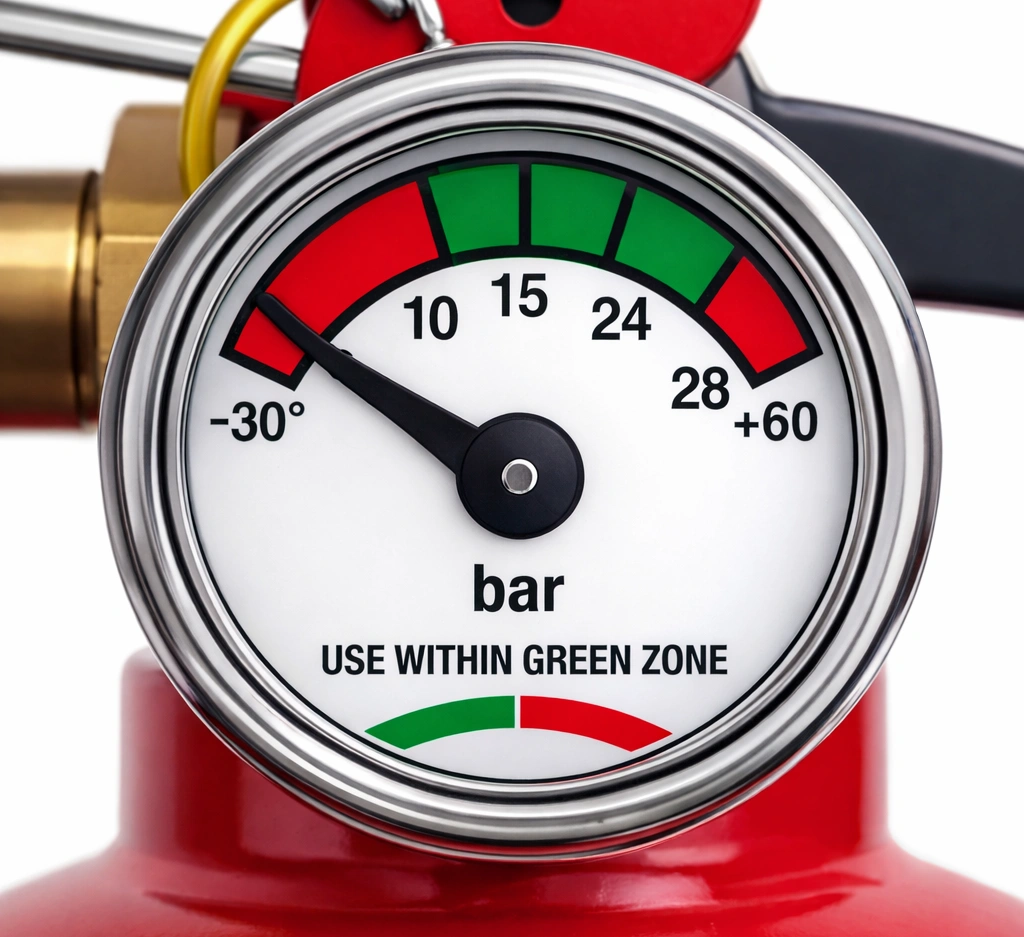
Fire Extinguisher Pressure Gauge
Product Description:
Importers of fire extinguisher pressure gauge know that they are a crucial, circular safety accessory for a fire extinguisher. The gauge is typically 63mm and is installed on portable, stored-pressure fire extinguishers to measure internal pressure. Furthermore, it features a color-coded dial, typically green for optimal pressure and red for low-overcharged states. It also ensures the unit is fully operational for emergency use. Supplier of fire extinguisher pressure gauges ensures they are designed for durability, using stainless steel or brass. Additionally, these gauges are essential for regular maintenance checks, refilling, replacing the unit, and alerting users when service is needed.
Additional Details:
- Brand: Somya Pyrotek Services Pvt. Ltd.
- Model: Fire Extinguisher Pressure Gauge
- Pressure Range: 0–25 bar
- Accuracy Class:6 or 2.5
- Operating Temperature: -20°C to 60°C
- Material: Brass, Stainless steel, and Zinc alloy
Key Features of Fire Extinguisher Pressure Gauge
Let’s discuss the key features of the gauge offered by the reliable importers of fire extinguisher pressure gauge that every individual should know:
- It displays three clear zones for quick interpretation: Green for operating, Left Red stands for undercharged (needs recharge), and Right Red stands for overcharged (hazard).
- The ABC fire extinguisher valve importer in India ensures that the gauge converts internal pressure into mechanical motion. Thus, it moves the pointer across the dial.
- It is constructed with a brass body and a sustainable plastic or glass lens to resist severe environments and corrosion.
- A fire extinguisher gauge features a 1/8-inch BSP or similar connection, providing secure, leak-proof attachment to the valve assembly.
- It is designed to work reliably in a broad range of temperatures, usually from -20°C to 60°.
- Supplier of ABC fire extinguisher valves and gauges ensures that it enables immediate manual checks without specialized equipment, ensuring the device is ready to use.
Application and Indicators of Fire Extinguisher Pressure Gauge
- Industrial & Process
- Inspection & Maintenance
- Automotive
- Medical
- Dimensional & Physical Metrology (Metrology Gauges)
- Material and Electrical Measurements
- Specific Industrial Applications
- Fire Sprinkler Systems
- Fire Pump Systems
- Standpipes
- Fire Hoses & Testing
Technical Configurations of Fire Extinguisher Pressure Gauge
| Configuration Area | Options / Types | Technical Notes / Typical Specs |
|---|---|---|
| Gauge Function Type | Indicating gauge (visual only) | Most common on stored-pressure extinguishers. Shows charged / under / over |
| Test/Service gauge (calibration-grade) | Used by service technicians, more accurate, and often not permanently installed | |
| Pressure Sensing Method | Bourdon tube | Industry standard. Durable, mechanical, low cost |
| Diaphragm | Used in compact designs, more sensitive to vibration | |
| Pressure Range | 0–200 psi | Common for water/foam units |
| 0–300 psi | Very common for ABC dry chemical | |
| 0–400 psi | Used where higher nitrogen pressures apply | |
| Nominal Operating Pressure | ~100 psi | Some water/foam units |
| 195 psi | Extremely common for ABC dry chemical at 70°F (21°C) | |
| 240–250 psi | Some higher-pressure designs | |
| Dial Indication Zones | Red / Green / Red | Standard layout: Undercharged / Charged / Overcharged |
| Marked PSI only | Some industrial units show only numeric PSI | |
| Dial Diameter | 23–25 mm (mini) | Compact extinguishers. Less readable |
| 40–50 mm (standard) | Most common and best balance of size/readability | |
| 60+ mm (large) | Industrial/wheeled units | |
| Connection Type | Bottom mount | Common for extinguisher valves |
| Rear mount | Used on some special layouts | |
| Thread Standard | 1/8″ NPT | Very common in North America |
| M10×1 / M11×1 | Common metric options | |
| Custom threads | Often manufacturer-specific | |
| Materials (Body) | Brass | Corrosion-resistant, common |
| Stainless steel | Used for harsh environments | |
| Zinc alloy | Lower-cost gauges | |
| Lens Material | Acrylic | Most common |
| Polycarbonate | Better impact resistance | |
| Glass | Rarely used in industrial gauges | |
| Dial Face Material | Aluminum | Stable, durable |
| Plastic | Budget units | |
| Seal / Environmental Rating | Non-sealed | Indoor use only |
| Gasket sealed | Better moisture protection | |
| IP65+ style sealed | Industrial and outdoor use | |
| Accuracy Class | ±5% FS | Typical low-cost extinguisher gauge |
| ±2.5% FS | Higher-quality gauge | |
| ±1.6% FS | Technician/service gauges | |
| Temperature Compensation | None | Cheap gauges may drift with temperature |
| Calibrated for 20°C / 70°F | Most are “nominal” at room temp | |
| Wide temp design | Better stability across -40°C to +60°C ranges | |
| Pressure Medium | Nitrogen | Most stored-pressure ABC units |
| Air | Some water units | |
| Mounting Style | Direct mount to valve | Standard |
| Remote mount via capillary | Rarely used in special industrial systems | |
| Safety Features | Blow-out plug/back | Prevents lens explosion in case of overpressure |
| Restrictor | Limits gas release if the gauge fails | |
| Compliance / Standards | UL-listed gauge | Common requirement in the US market |
| EN3 compatible | Common in EU markets | |
| Manufacturer-certified | Seen in many regional designs |
Maintenance Tips for Fire Extinguisher Pressure Gauge
Buying a fire extinguisher pressure gauge from reliable importers of fire extinguisher pressure gauge is easy, but neglecting proper maintenance can cost you time, effort, and money. Furthermore, we have compiled maintenance tips that are mentioned below that will help you keep your gauge clean and usable:
- Importers of fire extinguisher pressure gauge will advise you to inspect the pressure gauge dial monthly to ensure the needle is within the green operating zone.
- Don’t forget to recheck the plastic tamper seal around the safety pin. Ensure that it’s sealed, packed, unbroken, and the pin is securely in place.
- Check for dentsm rus, or corrosion on the pressure gauge casing and the cylinder body.
- After buying a gauge from the supplier of fire extinguisher pressure gauges, make sure to keep the gauge face visible and clean, inspecting the label and instructions are legible.
- For models with a “push-to-test” gauge, press it to check if it registers.
- If the needle of the gauge is in the red direction (low pressure), immediately rush to have the unit replaced or serviced by the reliable importers of fire extinguisher pressure gauge.
- Carefully and gently shake dry chemical extinguishers once a month to prevent the powder from compacting or settling.
Why Choose Us to Purchase a Fire Extinguisher Pressure Gauge?
In fire safety, accuracy and reliability are of utmost importance. In the case of fire extinguisher pressure gauges, an inaccurate reading can put your safety at risk. At Fire Extinguishers India, you are getting the best combination of trust, quality, and expertise.
We understand that a fire extinguisher is effective only if the pressure gauge is in good condition. This is why we offer high-precision pressure gauges for fire extinguishers. Whether you are in business, industry, or safety operations, our pressure gauges deliver long-term performance and peace of mind at competitive prices. Furthermore, we have mentioned some potential reasons why you should choose us when it comes to picking the best importers of fire extinguisher pressure gauge:
- High-quality, corrosion-resistant pressure gauges
- Accurate readings for maximum fire safety readiness
- Various compatibility options with other fire extinguishers
- Strict quality checks and compliance with industry standards
- Experienced technical support and product guidance
- Bulk supply capacity with timely delivery
- Cost-effective solutions without quality compromise
Frequently Asked Questions
If the needle is pointing towards the left red zone, the fire extinguisher is undercharged, hence the need for recharging/servicing. In addition, if the needle has already entered the right red zone, the extinguisher may have been overcharged, which is risky. In this case, it is advisable to have the extinguisher checked.
Mostly, the measure applies to stored pressure-type portable fire extinguishers. However, the measure may not be applicable to all fire extinguishers. The measure is largely dependent on the thread type (e.g., 1/8 BSP, 1/8 NPT, M10x1) and the valve type. It would be wise to check the thread and the specifications of the fire extinguisher you need to connect.
Here, we have mentioned the broad range of gauges and their temperature limits:
- Pressure Range: 0–25 bar
- Operating Temperature: -20°C to 60°C
It is suggested that the pressure gauge be checked monthly, simply to confirm that the needle is in the green zone. You should replace the gauge if:
- The needle gets stuck in the red zone
- The dial seems to be cracked or fuzzy
- Rust/corrosion
- Issues arise during inspection or refill