Automatic Dry Powder Fire Extinguishers- Maintenance Tips to Keep Them Effective
Automatic extinguisher maintenance is crucial and must be done regularly. During fire emergencies, malfunctioning or poor performance of these fire safety devices can lead to loss of life and extensive property damage. Thus, an automatic dry powder fire extinguisher must go through strict maintenance checks to ensure that they are functional and ready for deployment at any second. More importantly, residential, commercial, and industrial spaces are bound by law and compliance regulations, making it mandatory to maintain fire extinguishers.
In this blog, we will provide you with important maintenance tips that will help you keep the automatic fire extinguishers in ideal conditions and ready for deployment. These maintenance tips are essential as special equipment, such as dry powder fire extinguishers, has different delicate parts and requires additional attention. Following the professional maintenance tips also extends the life of fire extinguishers, making them operational for a sustainable amount of time.
The Crucial Need for Maintenance in Automatic Dry Powder Fire Extinguishers
An automatic dry powder fire extinguisher is designed to work without manual intervention and is installed in places that are quite distant. Therefore, every automatic fire extinguisher should remain in ideal working condition so that it can be trusted during fire emergencies. Routine inspections are the first step towards maintenance as they help in identifying defects or potential degradation in the fire extinguishers. Once the malfunctioning or expired fire extinguishers are identified, they are either replaced or sent for adequate repairs.
Professional Maintenance Tips for Automatic Fire Extinguishers
You will perform critical maintenance in the following points, which will help you keep your automatic fire extinguishers in the ideal condition for superior fire safety performance:
1. Set a Regular Time Interval for Maintenance Inspection
Fire extinguisher maintenance is not a one-time operation, but a continuous process that must be done at regular intervals. Thus, you must define a set time interval for the maintenance inspection and work. Proactive maintenance inspection prevents severe malfunction and detect in the early stage, making the overall maintenance progress quick and convenient. Additionally, you do not need professional assistance for regular maintenance inspection, as any employee or worker with minimal training can perform these checks with high efficiency.
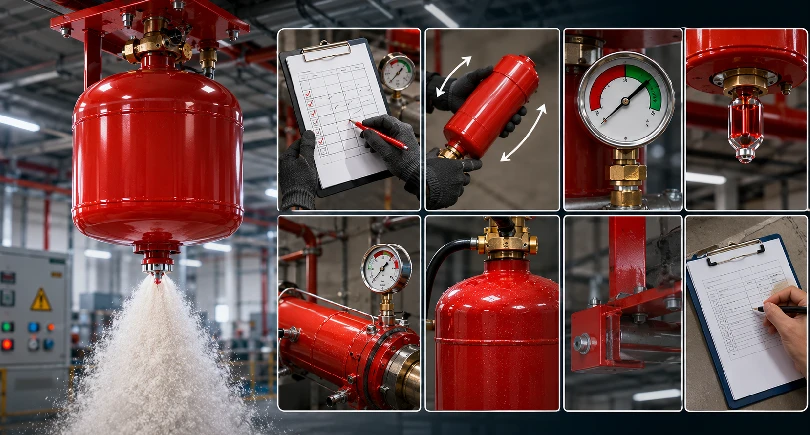
2. Shake the Cylinder
An automatic dry powder fire extinguisher uses a multi-purpose fire extinguishing agent, monoammonium phosphate. The extinguishing agent in these fire extinguishers is in dry powder form, as the name suggests. Therefore, it usually settles down after sitting idle for a long time, which can reduce the efficiency of fire suppression. After settling down, the fire extinguishing powder forms solid lumps, further impacting the fire protection ability. The ideal way to deal with this is to shake the fire extinguisher and hold it upside-down. Shaking or gentle agitation disperses the dry powder throughout the extinguisher vessel.
3. Double Check the Pressure Gauge
The pressure gauge is a critical component of the fire extinguisher as it shows the pressure level inside the fire extinguisher vessel. It indicates whether the pressure inside the vessel is in working condition or not. Fire extinguisher vessels must have a certain amount of pressure inside them in order to propel the extinguishing media and spread it across a wider radius. Hence, you must check the pressure gauge on every fire extinguisher without fail. In case the pressure is lower than the mandatory amount, take the fire extinguisher out of service immediately and replace it.
4. Check the Thermal Bubble for Cracks
The thermal bubble is a delicate component present in an automatic dry powder fire extinguisher that breaks at high temperature, triggering the fire extinguisher. During the fire extinguisher maintenance check, look for any visible cracks or deformations. This is important because malfunctioning thermal bubbles will not trigger the fire extinguisher at the right time, leading to costly damage to precious life and property.
5. Schedule Hydrostatic Testing
Hydrostatic testing is a specialized test that is only required once every 5 or 12 years, depending on the fire extinguisher type. Or, this testing is also performed immediately in case there are any visible cracks or deformation in the fire extinguisher vessel. During the test, the fire extinguisher vessel is checked for its structural integrity and its durability to hold high-pressure gas and fire extinguishing agent. Done under professional supervision, the fire extinguisher vessel is emptied and filled with high-pressure water to see if the vessel can hold it safely without cracking.
6. Check for Physical Damage
While it is common sense to check the fire extinguisher for physical damage, it is often ignored. You must check every part of the out body during the maintenance. The physical inspection is done to detect corrosion on the outer body, cracks in the vessel, or any sign of damage that may impact the fire suppression performance. During the physical checks, the mount of the fire extinguisher is also inspected, the bolts are, and their integrity is verified carefully.
7. Document the Maintenance Checks
Another important aspect of the fire extinguisher maintenance is documentation. The number of malfunctioned extinguishers, the causes of malfunction, and every detail must be mentioned in the documented file. Keeping detailed documentation ensures a smoother and more efficient maintenance process in the future. The documentation also helps during the audi checks and acts as a strong proof of maintenance work, verifying compliance with strict safety regulations.
Concluding Note from Fire Extinguishers India
Knowing the intervals at which your fire extinguishers need to be serviced is fundamental to ensure that your property stays both up to date and safe. Visual inspections should occur every month, whereas opting for professionals to make sure that your automatic dry powder fire extinguishers are inspected and maintained according to the relevant standards.
At Fire Extinguishers India, we offer professional servicing of fire extinguishers for industrial and commercial properties. Moreover, our team of expert and skilled engineers services all types of fire extinguishers, performs any essential repairs, replacements, and even supplies documentation. Connect with us today to get more precise information about our wide range of services.
FAQs
Ans: Yes. Even new fire extinguishers can fail to function due to pressure loss, accidental interference, corrosion, and damaged hoses. That is why annual servicing and regular inspections make sure that every fire extinguisher is still working perfectly when the time comes.
Ans: Yes, it is crucial to commission newly installed extinguishers to check their installation and appropriateness for dealing with the fire hazards on site. Furthermore, these extinguishers must also be serviced on an annual basis.
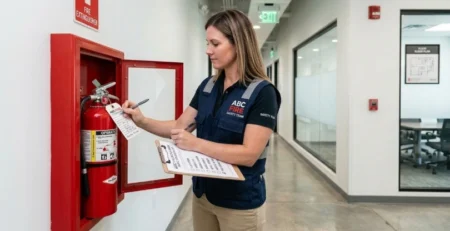
Ans: Fire extinguishers must be checked regularly, preferably once per month, to make sure that:
- They are easily accessible
- Their pressure gauge is within the proper range
- There is no apparent damage or tampering
Ans: No. While it is possible to conduct regular visual inspection of automatic dry powder fire extinguishers, annual servicing has to be performed by a competent technician.