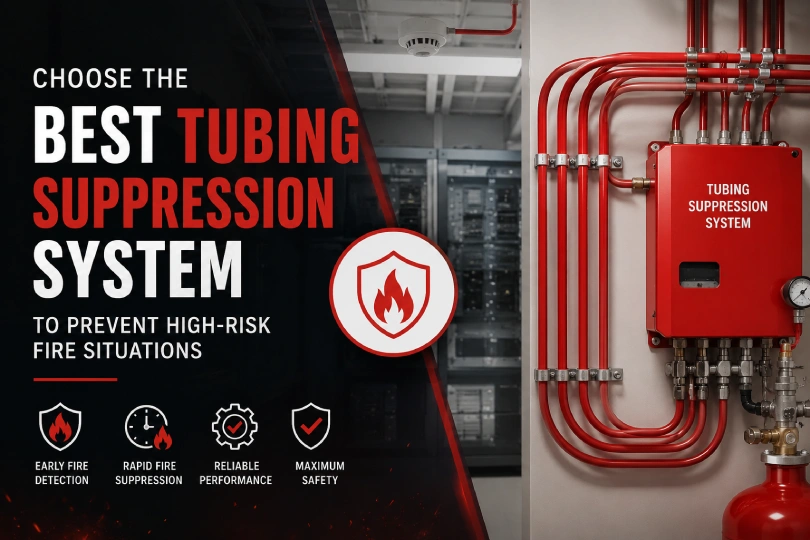
Choose the Best Tubing Suppression System to Prevent High-Risk Fire Situations
Whether its residential, commercial, or warehousing, every section is expanding faster than ever. With the e-commerce industry booming, logistics hubs developing, and manufacturing storage growing, millions of new sectors are coming every year. Thus, it plays a significant role when choosing the best tubing suppression system to prevent fire situations. However, the most important question is: how safe is your property from unexpected fire?
Furthermore, selecting the right tubing fire suppression system for your commercial or residential property is imperative for ensuring the overall safety, reducing property damage, and supporting adherence with fire safety regulations. With endless options available, including foam-based, gas-based, and water-based, it can be problematic to determine the best option for your particular needs and preferences. Likewise, in this comprehensive blog, we will discuss the key elements that you must consider when choosing a tubing suppression system and make the right decision that aligns with your safety.
What is Tubing Suppression System?
A tubing suppression system is also known as a tube-based or trace-tube system. Also, it is an automatic, localized fire safety solution. It uses a flexible, heat-sensitive polymer tube connected to a fire extinguishing agent cylinder to quickly detect and extinguish fire exactly at its source. Additionally, these suppression systems are highly popular for securing enclosed, high-risk spaces, such as machine enclosures, electrical panels, and server racks.
Key features:
- It operates entirely on pneumatic means that work automatically. Additionally, this system operates without any battery or external power, ensuring continuous 27 by 7 protection, even in situations where there are severe power outages.
- The heat generated by the incipient fire causes a rupture in the tubing once it attains the maximum temperature of the tubing. Therefore, due to the reduction in pressure, the cylinder valve opens up and releases the suppressant into the target region within seconds.
- Through direct discharge using the new nozzle (burst point in the tube suppression system), the suppressant works directly on the affected machinery only and does not affect the whole building.
- Due to its simplicity in structure with few mechanical components, this type of fire suppression system rarely suffers false alarms and needs very little maintenance.
Technical Configuration of Tubing Suppression System
| Component | Technical Configuration |
| Tubing Size | 2-3/8″, 2-7/8″, or 3-1/2″ production tubing (as per well design) |
| Tubing Material | API 5CT Grade J55, N80, L80, P110, or corrosion-resistant alloy (CRA) |
| Working Pressure | 3,000–10,000 psi (depending on well conditions) |
| Temperature Rating | Up to 150–200°C |
| Safety Valve | Surface-Controlled Subsurface Safety Valve (SCSSV) installed in tubing |
| Wellhead Connection | API 6A tubing head and tubing hanger |
| Packer | Permanent or retrievable production packer rated for well pressure |
| Flow Control | Production choke valve and wing valve |
| Monitoring | Pressure and temperature gauges; optional downhole sensors |
| Control System | Hydraulic, pneumatic, or electro-hydraulic control panel |
| Leak Protection | Metal-to-metal seals, elastomer seals, and pressure-tested connections |
| Applicable Standards | API 6A, API 14A, API 5CT, API 17D (offshore), ISO 10423 |
Factors to Consider When Choosing the Tubing Suppression System
The following are the important key considerations when selecting an ideal tubing suppression system:
1. Enclosure Dimensions & Tubing Length
The dimensions of the enclosure to be covered play a vital role in determining the appropriate tubing suppression system. It is essential to take the width, height, and depth measurements of the enclosure before installation. The measurements help establish the proper length of the tubing to cover the entire enclosure. The tubing should be fitted in such a way that it covers all the areas where there might be a fire outbreak. After the entire enclosure is fitted, the system will detect the high temperatures immediately and release the fire-fighting agent. Proper fitting of the tubing is also beneficial in reducing fire hazards and maintenance costs.
2. Maintenance Needs & System Reliability
An efficient fire suppression system must always be ready to offer its services. This makes maintenance one of the significant considerations. Fortunately, the tubing systems have a simple design and have few movable components. This means that the chances of breaking down are low, making them very reliable. Regular inspections and maintaining the tubing in good condition are crucial since they will help keep the pressure of the system steady. A system of high quality is more likely to serve you efficiently and for many years without any problems.
3. Extinguishing Agent
Another imperative factor to consider is the type of extinguishing agent used. The modern tubing fire suppression systems use clean agents like FM-200 or Novec 1230. These clean agents are very efficient, and they can extinguish fire without leaving any residue. This makes them ideal for electrical panels, server rooms, and other electronic environments. Using a clean agent ensures that there will not be any fire damage or destruction of your valuable electronics. Unlike water or powder fire-fighters, the clean agents do not leave any residue after discharge. Choosing the right extinguishing agent is necessary since it will give you both safety and efficiency of your equipment.
4. Power Source and Activation Method
The main advantage of the tubing suppression system is that they are automatic and does not require power for operation. The systems have pneumatic detection tubes that react to high temperatures. After starting, the detection tube bursts at the place with the highest temperature and discharges the fire-fighting agent immediately. Since the system operates independently of external power, it works effectively during power failure or outage, making it very reliable. You can choose the direct firefighting system that discharges the agent through the burst tube or the indirect system that discharges the agent through a valve. In this case, the burst tube will activate the valve that releases the agent and floods the enclosure with the agent.
5. Installation and Space Constraints
One of the characteristics of the tubing fire suppression systems is that they can be fitted in small and inaccessible areas where other fire suppression systems cannot be used. The flexibility of the tubing enables easy installation around the equipment present in electrical cabinets, control panels, server racks, vehicle engine compartments, and industrial machinery. Before purchasing the system, ensure that the tubing can be installed safely using brackets or clips without affecting the moving components. Installation of the system will result in covering all the vulnerable areas by taking full advantage of the space.
Concluding Here!
The selection of a suitable tubing suppression system is an essential decision that must be made wisely. Considering various factors like fire risks, enclosure dimensions, extinguishing agents, system operation, installation flexibility, maintenance requirements, and regulations, among others, is essential in choosing a proper system.
At Fire Extinguishers India, we provide the best quality tubing fire suppression systems to protect electrical panels, industrial machinery, server rooms, vehicles, and other enclosures. Our certified products combine advanced technology and reliability to safeguard your business from fire hazards. We are here to help you with our expert advice and efficient fire protection solutions.
Frequently Asked Questions
The best tubing fire suppression system for electrical panels utilizes clean agents such as FM-200 or Novec 1230. This system detects heat right at the source and extinguishes the fire without causing any damage to delicate electronic parts or leaving any residue. It is the best solution for control panels, server racks, UPS rooms, switchgears, and other areas where immediate response is necessary.
A tubing suppression system operates through the use of heat-sensitive polythene tubes filled with pressure. Once there is fire in an area, these tubes burst at the spot with the highest temperature, triggering the release of the extinguishing agent to the fire spot. This method involves no electricity it is very reliable in case of a power outage.
Yes, although the maintenance needs of a tubing suppression system are minimal compared to those of conventional fire protection systems, this system is required to be inspected periodically. This ensures that the integrity of the tubing is checked and that the cylinder pressure is within the acceptable range.
Yes, the tubing suppression system and traditional fire extinguishers are not comparable because they have different purposes. The traditional fire extinguisher requires human intervention for it to operate, while the tubing suppression system detects and suppresses the fire at the source automatically.