
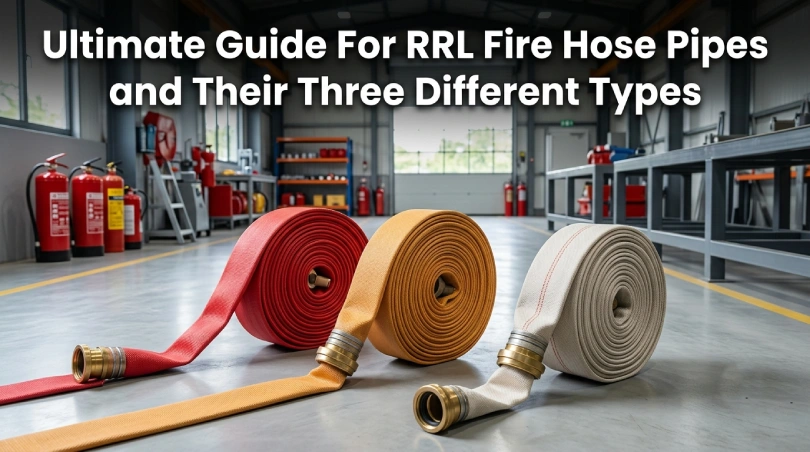
Ultimate Guide For RRL Fire Hose Pipes and Their Three Different Types
The presence of perfectly rolled RRL Fire Hose pipes can be seen at every building complex we enter. These are essential to install in accordance with fire safety ethics and need to be maintained frequently for efficient results. The presence of well-equipped fire safety solutions includes fire extinguishers, hoses, hydrants, sprinklers, and many more. In all this, the equipment, from small to large, includes fire hoses, which are one of the most important parts of fire safety solutions. All the pipes might look the same, but in reality they are divided into different categories that have their own abilities.
There are three different types of these RRL Fire Hose pipes, and choosing the right one isn’t just a checklist but a vital decision. Because one wrong choice can cause disruption and affect the effectiveness of firefighting scenes, increase maintenance costs, and reduce overall reliability. If you are trying to understand what these RRL hoses are and what these three types do to pick the best one for your building. Then this is the right guide for you, and here we will explain everything in simpler terms.
What are RRL Hose Pipes & What Does RRL Signify?
RRL fire hose pipes are simple pipes that carry water from a hydrant or fire engine during firefighting scenarios. In this, the RRL comes in, which stands for Reinforced Rubber Lined, and is specifically built for handling high water pressure. These are highly flexible, making them super easy to deploy quickly in an emergency.
The RRL hoses are divided into two main components that facilitate their features:
- The inner layer consists of a perfectly smooth rubber lining that ensures efficient passage of water.
- Its external part includes a tough woven synthetic jacket.
With this blend of properties, these hoses turn out to be appropriate for use in routine fire protection systems as well as firefighting tasks.
It’s a misconception by many people that RRL simply stands for rubber lining inside the hose pipes because it describes the hose’s overall construction. Friction and leakage are decreased due to the presence of silver rubber lining, helping water flow smoothly. The lining is surrounded by a woven synthetic jacket that is high-strength, giving the hose extreme flexibility and the ability to withstand high operating pressures.
Some specialized hoses add a coating of protection to fight resistance against oils, chemicals, abrasives, moisture, grease, and harsh weather conditions. The construction of RRL fire hose has made it a preferred choice for modern firefighting systems in India.
The rubber lining on hoses is widely used across various applications in India due to its durability and reliable performance. Including commercial residential buildings, factories, shopping malls, hotels, hospitals, airports, educational institutions, municipal fire services, and industrial fire protection systems.
Decoding Three Different Types of RRL Hose Pipes
Even though the basic construction of Type 1, Type 2, and Type 3 hose pipes is the same. However, not each RRL hose is designed for the same environment, and Fire Extinguishers India can get you exactly the one you require. Some are made to withstand harsh industrial conditions like chemicals, oils, heat, and heavy abrasion, while some are used in standard building protection. The table below lists each type with its specifications and best-suited environments for use.
| Feature | RRL Hose Pipe Type 1 | RRL Hose Pipe Type 2 | RRL Hose Pipe Type 3 |
|---|---|---|---|
| Primary Environment | Standard commercial and residential fire protection systems | Tougher operating conditions requiring frequent use and repeated handling | The toughest working environments with exposure to harsh chemicals and severe abrasion |
| Best Suited For | Commercial office buildings, residential apartments, shopping malls, hotels, schools and colleges, hospitals, fire hose cabinets, and municipal firefighting | Warehouses, manufacturing plants, industrial buildings, commercial complexes, logistics centres, and utility facilities | Oil and gas industries, refineries, chemical plants, steel plants, heavy engineering facilities, marine applications, ports, and petrochemical industries |
| Standard Sizes | 40 mm, 50 mm, 63 mm, 75 mm | 40 mm, 50 mm, 63 mm, 75 mm | 40 mm, 50 mm, 63 mm, 75 mm |
| Available Lengths | 15 metres, 30 metres | 15 metres, 30 metres | 15 metres, 30 metres |
Advantages and Key Features of The Three Types
As we understand that each RRL fire hose pipe is different and has different abilities or applications it is used in. So here are the advantages and key features for each type to understand them better before choosing the one for your project.
1. Type 1 Fire Hose
Key Feature:
- The coat has a woven synthetic layer reinforced with fibers.
- It has a smooth rubber inner-layer material.
- It has flexibility and a lightweight nature.
- It can be deployed easily during emergencies.
- It can be used daily in firefighting operations.
Advantages:
- Its low cost makes it economical.
- It is easy to roll up and store.
- Minimal maintenance is required.
- Standard hydrants can use it.
- It suits various commercial buildings.
2. Type 2 Fire Hose
Key Feature:
- Important Features
- Strong construction material due to its artificial nature.
- More resistant to wear.
- Comparatively durable compared to Type 1.
- Capable of sustaining multiple uses.
- Suitable for harsh conditions.
Advantages:
- Increased lifespan.
- Improved abrasion resistance.
- Suitable for firefighting applications.
- Excellent performance under heavy usage situations.
3. Type 3 Fire Hose
Key Feature:
- Made up of Rubber lining.
- Polymer coating on its outer layer.
- Highly durable against wear and tear.
- Resistant to chemical agents.
- Weather-resistant capabilities.
Advantages:
- These hoses perform excellently under tough industrial applications.
- Lifespan increases under tough working conditions due to durability.
- Resistance to oils, greases, acids, and alkalis.
- Less frequent maintenance than other hoses.
Concluding Note!
RRL Fire hose for RRL seems to be just another component of firefighting equipment. But in reality, the RRL fire hose holds a vital position in fire safety equipment and acts as a backbone for firefighters during emergencies. Therefore, selecting appropriate hoses becomes quite essential. While you opt for installation or replacement of hoses, knowing the key difference between Type 1, Type 2, and Type 3 RRL fire hose becomes extremely necessary. Thus, one can ensure that he chooses a product that ensures their safety while meeting their requirements.
At Fire Extinguishers India, we manufacture high-quality RRL fire hoses specifically for commercial buildings, storage facilities, hospitals, schools, colleges, and industries. If you find yourself stuck choosing between several types of hoses, then worry not! Our experienced professionals will assist you with your decision-making process. They will guide you on the right hose size according to your requirements. Contact us at Fire Extinguishers India for comprehensive assistance, affordable products, and efficient firefighting solutions.
FAQs
The RRL hose pipes are Reinforced Rubber Lined fire hoses that are used to carry high-pressure water from fire engines or hydrants during emergencies. They have a rubber liner inner tube and an outer jacket of reinforced woven synthetic, making them most suitable.
The main difference among these three are there intended application and the level of protection they offer:
- Hose Pipe Type 1: It is designed for municipal firefighting and standard commercial use.
- Hose Pipe Type 2: It offers improved durability and supports higher usage environments.
- Hose Pipe Type 3: It is ideal for chemical plants, heavy industries, refineries applications because it has an additional protective coating.
There are several factors in the pressure of hoses, depending on hose type, size, manufacturer, and project specification. Before choosing, match your required working pressure with the manufacturer’s technical sheets to meet the requirements.
A pipe carrying an ISI mark on a fire hose implies that it completely meets strict Indian Standards. It assures customers of quality assurance, safety, and efficiency since it means that this hose has been produced within a certified quality control process.
Its longevity largely depends upon its usage, maintenance practices, and storage. With proper maintenance and storage, a hose may prove useful for many years to come, but they need to be physically checked rather than judged by age alone.