
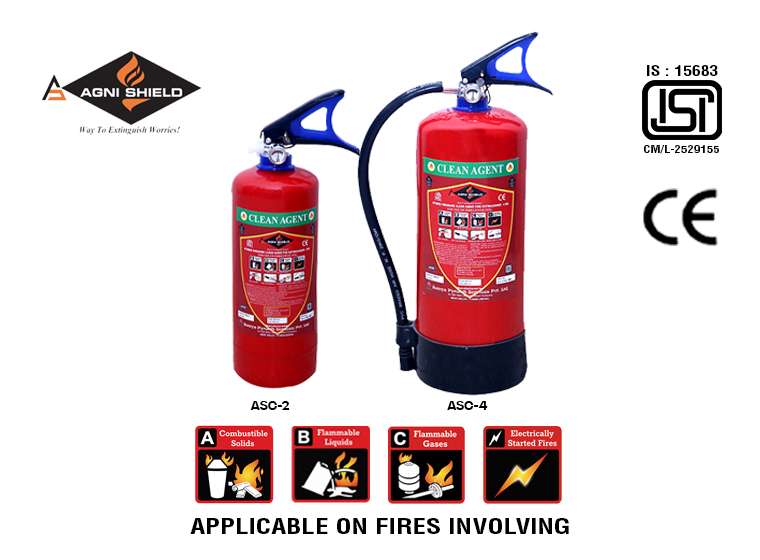
Clean Agent Fire Extinguishers
Product Specification
- Capacity: 2kg, 5kg
- Fire Class: Class A, Class B, Class C (editable)
- Extinguishing Media: Dry Powder IS 4308 (editable)
- Operating Temperature: -30°C to 60°C
Product Description
A clean agent fire extinguisher is a fire-fighting device that extinguishes fires instantly without using water. Its most significant advantage is that it doesn’t damage equipment, electronics, or sensitive documents. It releases a colorless, odorless gas that disrupts the chemical reaction that fuels a fire, controlling flames in seconds. A clean agent portable fire extinguisher is handy in areas such as offices, server rooms, data centers, laboratories, and kitchens, where water or foam can cause damage. A clean agent fire extinguisher is residue-free, so no cleanup is required after the fire is extinguished.
The operation of a clean agent fire extinguisher is also quite simple: pull the pin, aim the nozzle, and press the handle to spray the fire. They are environmentally friendly and provide time for a quick, safe evacuation. A clean agent extinguisher is a reliable and effective fire safety choice. Furthermore, whether you want to buy a clean agent fire extinguisher for server rooms or an office, it is imperative to understand everything about it. Let’s continue to the page to learn more precise details about it.
Application Area of Clean Agent Fire Extinguisher
Here, we have mentioned the application area of a clean agent fire extinguisher that every individual should know:
- Server Rooms / Data Centers
- Telecommunication Facilities
- Electrical Panels & Switchgear
- UPS & Battery Backup Rooms
- Computer Labs & IT Offices
- Medical Equipment Rooms
- Control Rooms in Industrial Plants
- Libraries and Archives
- Museums and Art Galleries
- Airports & Aircraft Hangars
- Ships, Yachts, and Marine Vessels
- Clean Rooms and Laboratories
- Semiconductor Manufacturing Units
- Banks and Financial Institutions
- Broadcasting Stations & Studios
- Luxury Hotels and Hospitality Kitchens
- Pharmaceutical Production Areas
- Nuclear and Power Plants
- Automated Manufacturing Facilities
- Residential High-Rise Apartments with Smart Tech
Key Features of Clean Agent Fire Extinguisher
- A clean agent portable fire extinguisher leaves no residue
- It is Electrically Non-Conductive
- It is entirely made up of Environmentally Friendly Material
- It offers Fast and Effective Suppression
- A clean agent fire extinguisher is safe for Occupied Spaces
- It is Suitable for Class B and Electrical Fires
- It offers No Damage to Sensitive Equipment
- It comes in a Compact and Lightweight Design
- It consists of a Wide Operating Temperature Range
- A Clean Agent Fire Extinguisher is Globally Certified and Standardized
Technical Specifications of Clean Agent Fire Extinguisher
| Model | ASC – 2 | ASC – 4 |
|---|---|---|
| Capacity (in kg) | 2 | 4 |
| Anti-Corrosive Inhibitor | Epoxy Polyester Powder Coating | Epoxy Polyester Powder Coating |
| Type of Extinguishing Media | HCFC 123 | HCFC 123 |
| Expellant | Pressurized with Nitrogen gas | Pressurized with Nitrogen gas |
| Minimum Effective Discharge (%) | 95 | 95 |
| Minimum Jet Length (in metres) | More than 2 | More than 2 |
| Discharge Time (in seconds) | More than 8 | More than 8 |
| Hydraulic Test Pressure (in kgf/sq. cm) | 35 | 35 |
| Operating Position | Upright | Upright |
| Operating Temperature Range (in Celsius) | (-30 + 60) | (-30 + 60) |
| Operating Valve | Squeeze Grip with Nozzle | Squeeze Grip with Discharge Hose |
| Fire Rating | 1A & 21B | 1A & 34B |
What are the Key Functions of a Clean Agent Fire Extinguisher?
Safety is paramount these days, whether in a home, an office, or a server room. And when it comes to fire safety, a clean agent fire extinguisher is a bright, modern choice. Its most significant advantage is that it extinguishes the fire without damaging your equipment or interiors. Let’s understand its seven key functions.
1. Fast Fire Suppression
A clean agent fire extinguisher controls fires in seconds. They interrupt the chemical reaction of the flame, suppressing the fire immediately. Quick action means less damage.
2. No Residue, No Mess
Its most prominent feature is zero residue. Furthermore, foam, powder, or water-based extinguishers can leave behind cleaning problems, but clean-agent extinguishers leave an immaculate finish. Just spray and you’re done, no sticking, no cleaning hassle.
3. Safe for Electronics
If you have expensive devices, servers, computers, or sensitive equipment, a clean-agent fire suppression system is best. Additionally, it doesn’t damage electrical equipment at all. For this reason, it is commonly used in data centers, labs, and offices.
4. Non-Conductive & Safe
Cleaning agents are non-conductive, meaning they don’t conduct current. Therefore, they are entirely safe in electrical fires. Also, you can use them without worrying about shock.
5. Eco-Friendly Action
Modern cleaning agents are environmentally friendly. Likewise, they don’t harm the ozone layer and have a low global warming impact. Thus, being eco-friendly is a big plus, along with safety.
6. People-Safe (Breathable in Low Dose)
A clean agent fire extinguisher is relatively safe to use around people. In addition, at low concentrations, they are breathable, reducing panic during evacuation.
7. Ideal for Enclosed Spaces
These extinguishers perform best in enclosed spaces because the agent spreads evenly in the air, controlling fires quickly. Thus, it includes server rooms, UPS rooms, control rooms, and labs, perfect for everything.
What are the Benefits Of a Clean Agent Fire Extinguisher?
Consider the key benefits of a clean agent extinguisher before purchasing one, tailored to your specific needs and preferences.
- With this automatic system of a clean agent fire extinguisher for server rooms, as soon as a fire is detected in its system, the clean agent will automatically be released and suppress the flames within seconds. It is done either by lowering the oxygen level or preventing heat from the flame.
- Environmental Benefits: Clean agents are “clean” for a reason: they have little to no potential to cause global warming or ozone depletion, which would be a hazard to the climate.
- Non-Conductive: When putting out fires near electrical equipment, you won’t have to worry about getting shocked if you use these fire protection fluids.
- No Cleanup: You can quickly resume regular business operations following a fire outbreak because clean agents are efficient at suppressing fires and leave no residue behind.
What are the Disadvantages Of a Clean Agent Fire Extinguisher?
- Not all are Suitable for Ingestion by Humans: If you are exposed to high concentrations of specific clean agents while in the fire suppression area, they may start to harm people if you remain there for an extended period.
- Cost: Due to their effectiveness, some brands of these cleaning agents can be expensive for a business to install in its establishment.
- Regulatory Matters: Depending on the specific rules that may be established, clean agents may occasionally be prohibited in particular locations.
How to Use a Clean Agent Fire Extinguisher?
If a fire breaks out in your office, server room, or any sensitive area, a clean agent fire extinguisher is the safest and most effective option. This clean agent extinguisher uses a special chemical gas instead of water or powder, extinguishing the fire at turbo speed without causing damage. Now the question is: how do you use it? Let’s understand it step by step.
Step 1: Understand the Severity of the Situation
First, remain calm. Quickly determine whether the fire is small and controllable. A clean agent extinguisher is best for small to medium fires, especially those near electrical, electronic, and sensitive equipment. Nevertheless, if the fire has spread significantly, immediately evacuate the area and call the fire division.
Step 2: Raise the Extinguisher and Get into Position
Hold the extinguisher by the handle, check the safety pin and nozzle. Maintain a slight distance while pointing the nozzle toward the fire, at approximately 6 to 8 feet.
Step 3: Opt for the PASS Technique
The golden rule for using almost every clean agent fire extinguisher for office is PASS, and fire extinguishers operate using this method as well.
a. P: Pull (Pull the Pin)
Firmly pull out the safety pin and remove it. Nonetheless, this pin prevents accidental discharge, so it’s essential to remove it.
b. A: Aim (Point the Nozzle at the Correct Spot)
Aim the nozzle at the base of the fire, where it’s starting. Spraying only on the flames will never effectively control the fire.
c. S: Squeeze (Press the Handle)
Press the handle firmly. The gas of a clean agent fire extinguisher for office will be released at high pressure and instantly cool the fire, suppressing the flame.
d. S: Sweep (sweeping from left to right)
Move the nozzle from left to right in a slow, controlled motion. Until the fire is entirely extinguished, continue sweeping.
Step 4: Observe the Area
Don’t turn back immediately after the fire is extinguished. Observe the area for a few seconds as the fire could ignite again. The clean-agent gas evaporates quickly, clearing the area and maintaining visibility.
5. Replace the Extinguisher
Always refill a used extinguisher, even if it’s been used only a little. A clean agent fire extinguisher is essential for your future safety.
Maintenance and Inspection Tips for a Clean Agent Fire Extinguisher
Here are some vital maintenance and inspection tips that you must follow to enhance the shelf life of the clean agent extinguisher:
- Ensure to inspect the fire extinguishers for any signs of physical damage. Additionally, do not forget to check that the pressure gauge and tamper-evident seal are intact, in place, and functioning accurately. As with monthly check-ups, an expert will ensure the clean agent extinguisher is working correctly and has the proper pressure range.
- Make sure that the discharge hose is not damaged or blocked for any reason. Likewise, the 0-ring on the release hose will also be replaced.
- Ensure that a clean agent portable fire extinguisher is positioned accurately. Additionally, ensure that you read the instructions carefully.
- Check the wall mountings.
- Check the fire extinguisher’s weight and details on every extinguisher label.
- Clean the fire extinguisher if needed.