ABC fire extinguisher Vs CO2 Fire Extinguishers – Which One is Best for Commercial Uses?
Choosing the right fire extinguisher is a significant step toward safeguarding your office or business space. Different fires require different classes of extinguishers, because using the wrong one can make the fire worse instead of controlling it. It is one of the primary reasons for understanding the key differences between ABC and CO2 type fire extinguishers. As we all know, each fire extinguisher type functions differently and is designed for specific types of fires. Furthermore, when individuals don’t know anything about extinguisher types, they might panic in such situations, use the wrong one, or be unable to stop the fire before it spreads.
That is why knowing the main difference between CO2 and ABC fire extinguishers helps you handle the situation and act actively with the right presence of mind during an emergency. Nevertheless, in this comprehensive blog, we will explore clear, easy-to-understand ways to choose the right fire extinguisher to safeguard your space and enhance your fire protection plan.
Understand the Basics of Different Fire Classes
When it comes to fire situations, it is categorised into multiple classes. It is mainly done to match the appropriate fire extinguisher with the right fire incident. Here, we provided a quick overview of different types of fire classes.
- Class A: Daily items, such as cloth, paper, or wood
- Class B: Easily flammable liquids, such as kerosene or gasoline
- Class C: Flammable gases, such as propane, CNG, LPG, and electrical fires from appliances, wiring, or switches
- Class D: Metal fires mainly in factories or labs
- Class K: Kitchen fire containing grease or oil
What is ABC Extinguisher?
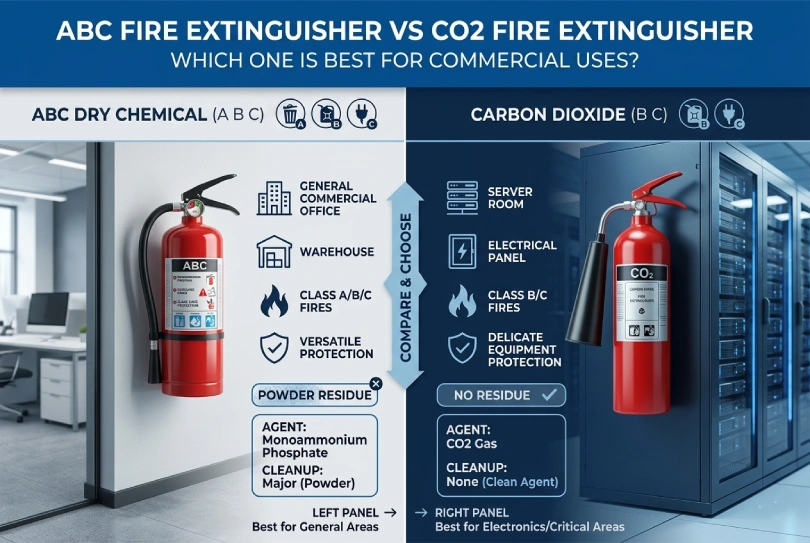
An ABC fire extinguisher is a versatile, sustainable, and multi-purpose piece of equipment designed to extinguish three standard types of fire: Class A (everyday combustibles, such as trash, wood, paper), Class B (easily flammable liquids, such as paint, gasoline, oil), and Class C (energized electrical tools). Likewise, ABC or water mist fire extinguishers typically use a dry-chemical powder (often monoammonium phosphate) to smother flames. This fire extinguisher is useful in places with multiple fire risks. Whether at work or home, ABC extinguishers are the first choice for fire safety. They are easy to install and use, and they cover the most common types of fire in daily life.
Pros
- One unit handles almost all common fire types.
- ABC extinguishers instantly smother fires by creating a string barrier between the fuel and oxygen, while simultaneously breaking the chain reaction that sustains the fire.
- The monoammonium phosphate powder is safe to use on a live electrical fire, meaning it will prevent the electricity from conducting back to the operator.
- They are the most affordable, common, and easily accessible fire extinguishers, offering the best value for general-purpose protection.
- It is designed for simplicity, as they can be easily operated using the basic P.A.S.S. method (Pull, Aim, Squeeze, Sweep), making them appropriate for untrained individuals during a fire situation.
Cons
- The chemical powder is quite corrosive and acidic, which can permanently damage assets, such as computers, delicate machinery, and electronics.
- Inhaling the dry powder can cause lung and throat irritation, exacerbate respiratory conditions like asthma, and trigger coughing.
- ABC powder does not prevent fires as effectively as other agents, increasing the risk of fire reignition if hot fuels remain.
- The dense dry powder cloud formed during discharge can significantly reduce visibility, making it challenging to see the fire or find exits in small, enclosed spaces.
Technical Configuration of ABC Extinguishers
| Parameter | Typical Specification (ABC Dry Powder Extinguisher) |
|---|---|
| Type of Extinguishing Agent | Mono Ammonium Phosphate (Dry Chemical Powder) |
| Fire Classes Covered | Class A (solid materials), Class B (flammable liquids), Class C (electrical fires) |
| Capacity Options | 1 kg, 2 kg, 4 kg, 6 kg, 9 kg |
| Cylinder Material | Mild Steel (powder coated / corrosion resistant) |
| Working Pressure | 12 – 15 bar |
| Test Pressure | 25 – 35 bar |
| Propellant Gas | Nitrogen |
| Discharge Time | 8 – 20 seconds (depends on capacity) |
| Discharge Range | 3 – 6 meters |
| Operating Temperature Range | –20°C to +55°C |
| Mounting Type | Wall-mounted / portable |
| Valve Type | Squeeze the grip valve with the safety pin |
| Pressure Indicator | Pressure gauge with green zone |
| Standards | IS 15683 / ISO / CE (varies by manufacturer) |
| Refilling / Maintenance | Recommended annually |
Situations to Use the ABC Fire Extinguisher
- Operate when paper, wood, or fabric is on fire.
- Operate when the fire was caused by a flammable liquid such as gasoline or paint.
- Operate when an electrical item, such as a computer or fan, catches fire.
- Operate in homes, cars, offices, and shops because the type of fire could vary.
- Operate when you’re not sure of the type of fire.
- Operate for kitchen fires involving oil and grease.
What is a CO2 Extinguisher?
CO2 type fire extinguishers are high-pressure cylinders filled with non-flammable CO2 (carbon dioxide) gas used to extinguish Class B (flammable liquids) and Class C (electrical) fires by displacing oxygen. A CO2 extinguisher can be easily recognized by a black label and a horn-shaped nozzle, which leaves no residue. Thus, these features make it an ideal choice for protecting sensitive electronics and delicate machinery.
Pros
- There is no mess left behind, saving money and time, and preventing damage to equipment and machinery.
- These are non-conductive and non-corrosive, so they are best used for electrical equipment, as they will not cause electrical shock to the user.
- CO2 is very effective in smothering the fire by removing the oxygen needed for the fire to burn, as it is a component of the fire triangle.
- The gas is very cold, which will cool the fuel source and ensure that it does not re-ignite.
- There is no mess left behind, and it is non-corrosive, so it is best used for expensive and sensitive equipment like electronics.
Cons
- It works by removing the oxygen, which may cause suffocation in a small, unventilated, and/or enclosed room.
- The horn gets very cold, and if held, the skin will freeze onto the horn.
- These are not used for wood, paper, and fabric, as they may not work properly for these types of fires.
- These have a shorter range and a discharge time of only 10-30 seconds.
Technical Configuration of CO2 Fire Extinguisher
| Parameter | Technical Specification |
|---|---|
| Type of Extinguisher | CO₂ (Carbon Dioxide) Fire Extinguisher |
| Extinguishing Agent | Liquefied Carbon Dioxide (CO₂) |
| Cylinder Material | High-pressure seamless steel cylinder |
| Capacity Options | 2 kg, 3 kg, 4.5 kg, 6.5 kg |
| Operating Pressure | ~55–60 bar at 21°C |
| Test Pressure | Around 250 bars |
| Discharge Time | 8 – 25 seconds (depending on capacity) |
| Discharge Range | 1.5 – 3 meters |
| Operating Temperature Range | –20°C to +55°C |
| Valve Type | Brass squeeze grip valve with safety relief |
| Discharge Hose / Horn | Non-conductive discharge horn |
| Fire Rating | Class B & Class C Fires |
| Safety Device | Pressure relief burst disc |
| Mounting | Wall bracket/floor stand |
| Certification / Standard | IS 15683 / BIS / CE / ISO (varies by manufacturer) |
| Colour Code | Red cylinder with black band (as per fire safety standards) |
| Refilling / Servicing Interval | Annual inspection, hydro test every 5 years |
Vital Situations to Use the ABC Fire Extinguisher
- Operate when electrical equipment fires, such as computers or printers.
- Operates well when fuel, oil, or alcohol is burning.
- Best for offices or labs because cleanliness is essential.
- Ensure you clean up any powder or mess after use.
- Not to be used for burning paper, wood, or cloth.
- Not to be used for cooking oil fire in the kitchen.
ABC vs CO2 Fire Extinguisher: Comparison Table
| Feature | ABC Fire Extinguisher | CO₂ Fire Extinguisher |
|---|---|---|
| Extinguishing Agent | Dry chemical powder (monoammonium phosphate) | Carbon dioxide gas |
| Fire Classes Covered | Class A (wood, paper, cloth), B (flammable liquids), C (electrical) | Class B (flammable liquids) and C (electrical) |
| How It Works | Smothers fire and interrupts the chemical reaction | Displaces oxygen and cools the fire |
| Residue After Use | Leaves powder residue that requires cleanup | No residue left |
| Best Use Locations | Homes, offices, warehouses, vehicles | Electrical rooms, server rooms, labs |
| Effect on Electronics | Powder can damage sensitive electronics | Safe for electronics (no residue) |
| Cooling Effect | Moderate cooling | Strong cooling due to CO₂ expansion |
| Visibility During Discharge | A powder cloud may reduce visibility | Clear discharge |
| Typical Nozzle Type | Hose/nozzle | Horn-shaped discharge horn |
| Weight & Pressure | Usually, lighter pressure systems | Often heavier cylinders |
It’s Time to Conclude Here!
We hope this blog post has provided you with precise details on the key differences between CO2 and ABC fire extinguishers. If you are searching for ABC, CO2, or water mist fire extinguishers, look no further than Somya Pyrotek Services Pvt. Ltd. We offer a wide range of fire extinguishers to ensure your space is well protected against fire. Thus, we ensure that we use premium, high-quality materials in manufacturing every fire extinguisher. So, do not wait any longer. Contact us today and purchase the best fire extinguisher at the most competitive price.
Frequently Asked Questions
If there are many computers and electronics in the office, a CO2 extinguisher would be preferable, as it leaves no powder residue. Still, an ABC extinguisher is quite useful.
Yes, it can be used for electrical equipment, as it is a fire extinguisher for all classes of fires. Still, a CO2 extinguisher would be better for electronics.
No, a CO2 extinguisher is not advisable for a kitchen fire. Instead, a special kitchen extinguisher, known as a Class K extinguisher, should be used.
The powder of an ABC extinguisher is slightly corrosive and may irritate your throat and lungs if inhaled. So, it is better to be a little more distant when using it and to make sure it is properly cleaned.